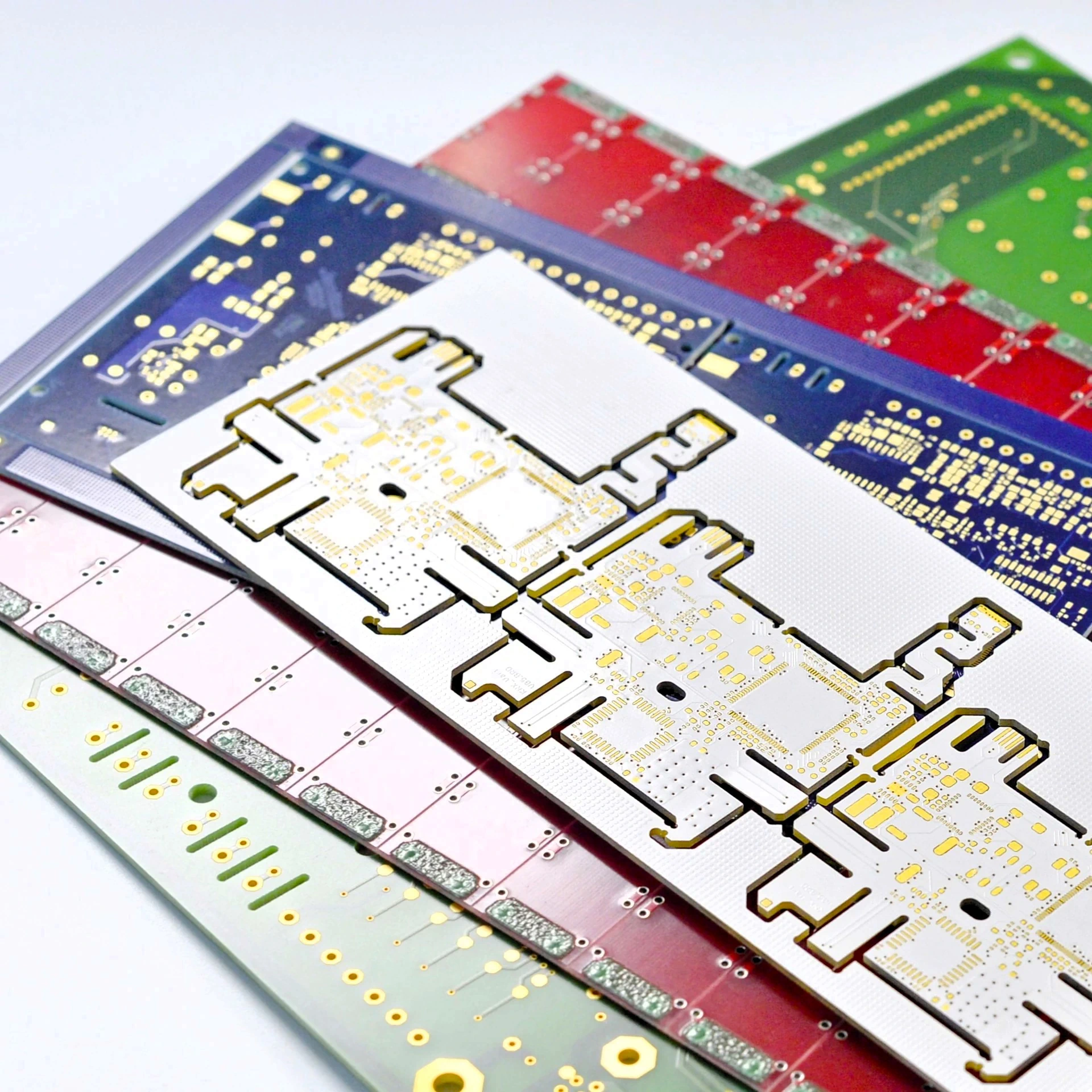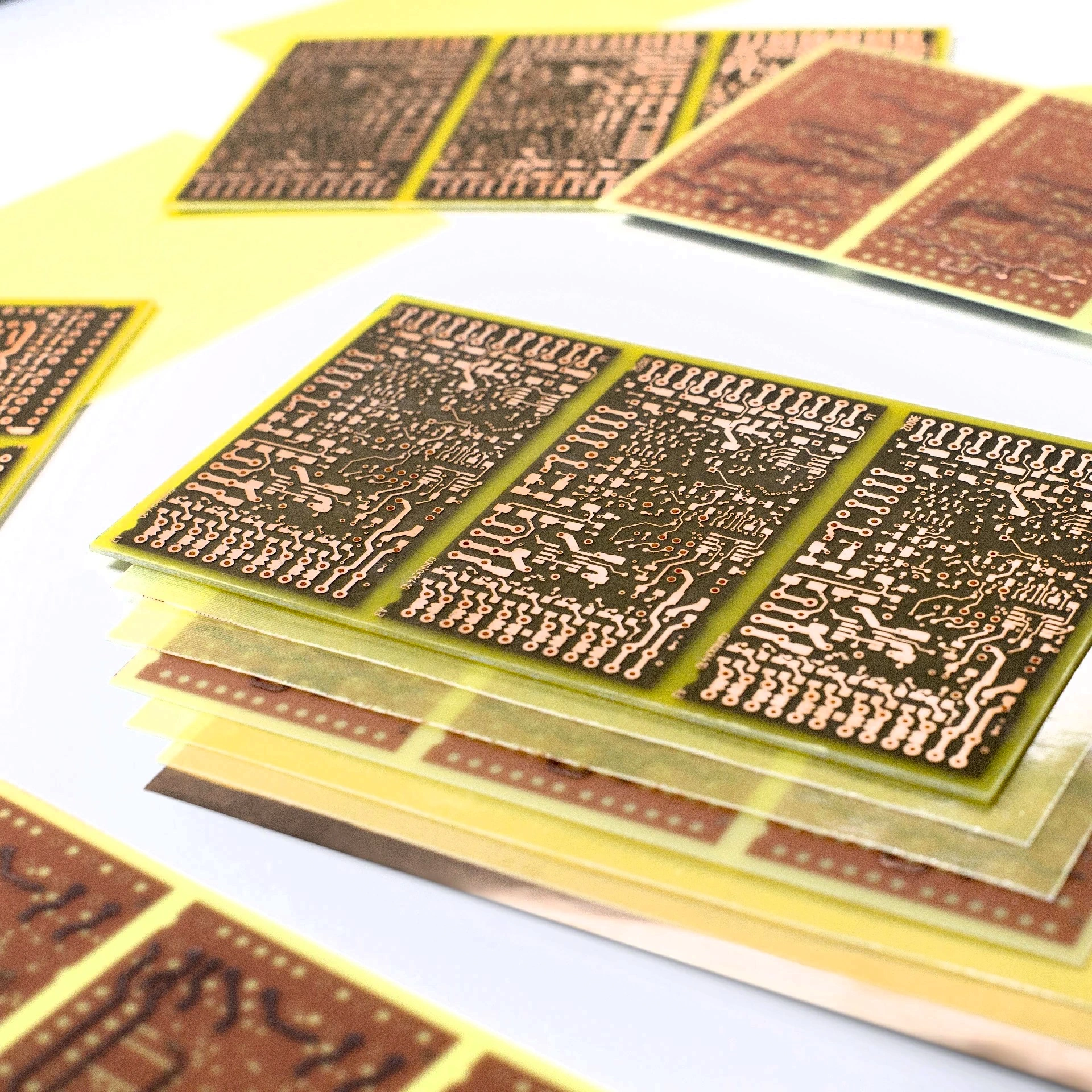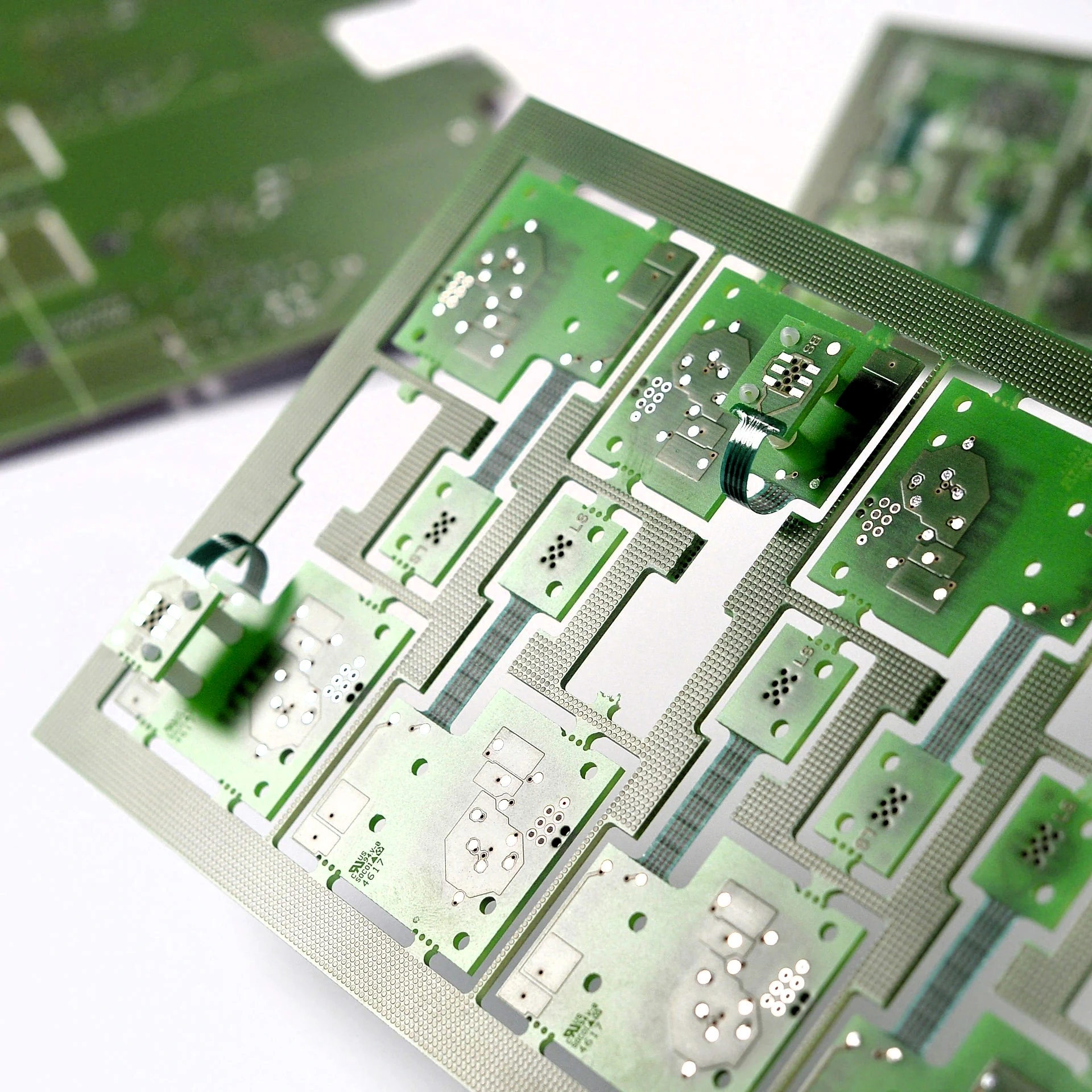
The MLB images are prepared on CAM from the CAD data supplied. Generally
some
of the work done includes:
design rule check
minor design edits such as removal of unconnected
pads from internal signal layers and enlargement of solder mask pads
step and repeating of images to fit within one
of our 2 standard panels
(640 mm x 535 mm or 610 mm x 460mm);
addition of test coupons, venting patterns to inner
layers and thieving patterns to outer layer
Films are then laser photoplotted and used as phototools in imaging. The films are
punched
with registration slots.
Innerlayer Imaging Artwork Punch
Accurate, Dependable, Artwork Tooling to meet your specific registration demands
A quality registration system begins with the ability to accurately punch imaged artwork.
With the added
capability of printed circuit board manufacturers to plot first generation
artwork, tooling the artwork
in relationship to the image now has significant advantage
in registration. Because the artwork is punched
after imaging and developing, plotter
pinning tolerance is eliminated and dimensional instability in
the film is accounted for.
The Artwork punch should have flexibility to be used for innerlayer and outerlayer
artwork
registration. All models from completely automatic to manual are offered with either 4 slot,
4 slot with edge tooling, tooling slots along two edges ("L" configuration) or custom
designed
to fit a present tooling need. Adjustability and maintainability are designed
into each machine. All
models available in any of the featured configurations or custom
built as required.
Eliminates operator judgement
The Automatic Post Image Artwork Punch represents the most advanced artwork punching
system available
today. It incorporates a computer driven vision system
with
a precision
X-Y-& Egrave; positioning
vacuum table and extremely accurate
tooling.
This provides the
ability to automatically locate the artwork
under the
cameras and
determine the correct
location
before punching. The machine is constructed on a
granite base for stability and
accuracy. To assure total quality
control, statistical data
is collected
on every cycle. This
includes spread data,
average error and standard
deviation. The data provided can
be
used to accept
or reject artwork before punching
or for artwork compensations. The
Automatic
Artwork
Punch offers the accuracy and
consistency to assure the best possible
front-to-back and layer-to-layer
registration.
Pre-Production-Department
CAM - Computer Aided Manufactoring
Orbotech: CAM Valor Genesis with 6 work stations (t010,t015)
Art-Work-Photo-Fabrication
Orbotech: Ultra-fast High Quality Automated Laser Plotter LP 5008, with extremely fast
plotting
speed and exceptional accuracy, the LP-5008 enables high throughput, top
quality
plotting.
- Image Size up to 37" x 34"
- Up to 1/8 mil Resolution
- Scanning, DRC, and Custom Tooling Options
- Real-Time Conversion of Scanned Digital Dato to Vector Data
- Automatic Alignment and Scaling
Multiline: Automatic Phototool (Art Work) Registration Unit
Images To help you quickly access the services we offer, the following is a guide to the
preferred requirements for producing quality Printed Circuit Boards.
Can be supplied as artworks, penplots, photoplots or photoplot files, so long as
the quality and registration of the images is of a standard that will enable a good
quality board to be produced. Another important criteria is the presence of orientation
marks within the boundary of board. These marks could be the board reference so
long as it cannot be read from the other side. (This is for your protection to prevent
the boards made inside out).
Images should comply with design rules that will result in a board that will meet
performance and cost requirements.
- Scale must be given, tapes securely stuck to the backing sheet, track to pad & track
to track joints complete and the backing sheet clean.
- Scale must be given and be at least 2:1. Plots must also offer sharp edge definition
and traces dense enough for blocking light when photographing.
- Preferred on 7mil (178mm) thick base for stability. Films should be plotted on laser
photoplotter or on vector photoplotter using a minimum resolution of ½mil (13mm).
- Preferred in Gerber® format although accepted in other formats. (Refer to CID-014
for information on Documentation in Digital Form).
- files are the only acceptable form of supplying images for multilayers and boards with
fine (0.2mm or smaller) tracks.
Drawings Drawings must be supplied with each new job and should contain the following
information to ensure that the finished board is to your requirements.
- Always required even when a drill file is supplied, to enable inspection of panels
immediately after drilling and finished boards prior to despatching. Hole sizes must
be clearly represented with distinct differences between each size. Tolerances are not
required unless different to our standard of +0.1 / -0.05 mm.
- Preferred with overall mechanical dimensions including notches, cutouts and slots.
Also preferred is a positioning (datum) dimension (drilled hole is best). Tolerances
are not required unless different to our standard of + / -0.25 mm.
Other information required for
all boards includes:
board thickness (standard = 1.6mm)
base copper thickness (std = 18mm)
solder mask colour (std = green)
solder mask type (std = liquid photoimageable)
component legend colour (std = white)
bare board testing requirement (std
for multilayer and fine line production runs)
Extra information required for
multilayers includes:
special dielectric spacing requirements
(if important)
copper thickness of internal layers
(std = 35mm except for track width <0.25 mm )
lay up sequence (if important) numbering
component side as layer 1.
- Welcomed with CAD generated designs, except with pen plotted artworks due to
calibration differences between penplotter and the highly accurate CNC drilling
machines. Preferred in Sieb & Meyer format although accepted in other formats.
Art-Work / Film Preparation
It doesn't take much to join the first group and get more involved
with the board
fabrication process. Run a series of checks and balances that help prepare the data
set before sending it. Automated software is available to assist in this process, and
all designers should at least do the following:
Document layers and file names.
Take advantage of 274X.
Include IPC-D-356 netlist data
Check spacing
Identify potential drill problems.
Validate soldermask layers.
First off, make sure layers are properly aligned and ordered correctly. File names should
be meaningful, correlated with the layers, and explained to the fabricator in a README
file.
The
idea here is that the fabricator should be able to quickly understand what each
file is
and where it goes in the stackup.
If you wish to continue using Gerber data, switch to 274X. 274D is obsolete; the external
aperture information is more cumbersome and difficult for fabricators to deal with
because
they have to worry about translators and parsers to read the aperture table
information. As
a result, aperture data might be misinterpreted. Worse, someone might
have typed in the
information manually - and erroneously. By contrast, in 274X, all the
aperture information
is
contained within the Gerber file, which can be read by most CAM
tools automatically.
For netlists, IPC-D-356 is the preferred format for fabrication. It's widely used by many of
the bare-board test-fixturing machines and is one of the only true ways to identify power-
to-ground shorts. With the information in this format coming directly from the
engineering
CAD system, there's no danger of the fabricator "reverse engineering" the
netlist from
the
Gerber files.
Next up are the internal plane layers. For some reason, CAD engineers like them to be
"positive," but those types of layers lead to huge file sizes. Negative plane layers are
usually preferred by fabricators because they're easier to work with and have smaller file
sizes than positive layers. Remember, boards are manufactured en masse and must
be
stepped out into a panelized form. The result: Data sets with lots of unnecessary
positive
planes swell exponentially, bog down CAM systems, and crash photoplotters.
After the basic prep work is completed, step into the fabrication analysis arena, where
the game is one of checks and balances. You've got your design rules; fabricators have
theirs. Checks and balances can resolve any conflicts between the two.
Take soldermask layers, for instance. Often, these layers are not "intelligent" layers
within
a CAD tool; that is, there is not much in the way of capability checking within the
tool. As a
result, these are among the more troublesome layers for fabricators. The
solution here is
a fabrication analysis tool that can handle such issues as clearances,
coverage, webbing,
and so forth.
For instance, most fab shops want the largest possible clearances in a solder layer
so
that mask doesn't end up on pads. On the flip side, copper is not supposed to be
exposed. The two requirements - no mask on pads and unwanted exposed copper -
must be balanced. It is not easy to do. How can the designer help? Devise a
standardized clearance, or set the clearances at 1:1, and let the shop do the
soldermask
enhancement.
Here's another issue: the soldermask webbing between pads on fine-pitch surface
mount
devices. Most masks can go to 0.003" without the resist flaking off. However, if
the pads
are
so tightly grouped that the dams between them are less than 0.003", it's
better to construct
a mask opening over the entire group. That will make the fabricator's
life much simpler.
Bear in mind that a fabricator's spacing tolerances likely differ from yours. For example,
take the drill data. When laying out a board, you usually work with finished hole sizes.
However, a fabricator must drill a hole larger than the finished one, about 0.004" to
0.005" over, then plate down to the desired finished size. This can lead to problems in
maintaining annular ring requirements and copper spacing on internal layers. To
meet manufacturing specs, the fabricator might have to modify the data, and that's the
last thing you want.
So now we have an alternate reality: You've finished the PCB layout (check out those
negative planes!). You output the 274X and IPC-D-356 netlist files. The data are fed
into a fab analysis tool and run through their paces. Clearances are good. No possible
soldermask flaking. Spacing between the drills is just right. You hand the data set to
the fabricator, and voila! No unexpected phone calls, no changes in the layout, and the
fabricator happily sends back a good set of boards on time.
Our recommendations for the correct storage of PCBs
and MLBs
A.1 ) Brief desricption of the problem:
PCB`s, especially Multilayer boards are extremly sensitive towards moisture The
microscopic structure of the Multilayer material develops a strong capillary power that
soaks up the humidity of the surrounding air. Even under very dry conditions it is a
question of time that water accumulates in the stored PCB`s. For example: At storage
conditions of 20 C° and 35 % of humidity the weight of the epoxyraisin of the Multilayer
PCB`s rises 0,12 % due to the accumulation of moisture. If the capillary effect leads to
an increase of more than 0,17 % a gas pressure of 8-10 bar can be reached, causing
delamination Even if delamination tests are made after production, the danger of
delamination can rise again due to unsafe transportation and long storage times.
Therefore we would like to give you following proposals to avoid the described problems:
A.2 1 ) Storage conditions
PCB`s should be stored in heated and dry rooms. Constant low humidity is necessary
before the soldering processes start. A rapid fall in temperature of more than 7 degrees
causes condensation on the stored PCB`s. Humidity should never exceed 65 %. The
package must be kept intact although the polyethylene packages capability of keeping
humidity away is not really reliable.
A.3 2 ) Storage time
The storage time of PCB`s should be as short as possible. PCB`s should be taken out
due to the „first-in, first out“ rule. The the polyethylene packages should be taken
away
just before the assembling. Remaining PCB`s should be repacked again. To avoid
exposure to draught, the packages should be stored in boxes.
A.4 3 ) Soldering tests
PCB`s stored for over several months and being transported under questionable
conditions, should be submitted again to a soldering test, being equivalent to your
soldering process.
A.5 4 ) Heat conditioning of the PCB`s
In any case we suggest a drying process of the PCB`s in a stove to reduce the moisture
in the PCB`s to an acceptable minimum. Following parameters can be recommended:
A6)
Drying time:
Temperature C°
8 hours
120
10 hours
100
18 hours
80
Lower drying temperatures are also possible but need much more exposure time. We
also suggest to put the PCB`s vertically in the stove by using a rack. Good results can
be achieved if the assembling process of the PCBs is started immediatedly afterwards.
The time after drying should not exceed 48 hours not to rise the risk of delamination again.
Forming Microvias. (Demand for small holes is ramping,
with CO2 lasers leading the way)
Thanks largely to the proliferation of smaller, more complex electronics
devices such
as cell phones, personal digital assistants, and notebook computers, the PCB industry
is experiencing an overwhelming rise in demand for high-density interconnect
structures
(HDIS). The demand for HDIS translates directly into a vigorous market for
the
microvias
used in many of these multilayer substrates as well as in conventional
PCBs.
In 1998,
for example, the worldwide microvia market made up about four
percent of the
total
multilayer PCB market. By 2007 that market share is expected to
expand to nearly
30
percent (Figure 1).
Figure 1. Estimates predict microvia boards will comprise 29 percent
of all buildup boards by 2007.
Worldwide, the total microvia market approached $4 billion in 2000 - up 63 percent
over 1999 (Figure 2).1 By the end of 2001 the market should reach $5.6 billion - up
another 50 percent over 2000. These same data show Japan as the microvia leader,
followed by Europe, Asia, and North America. Several factors contribute to this
remarkable expansion, the most important being the steadily increasing interconnect
density of PCBs. Microvias have become an attractive interconnect alternative when
the wiring density on a PCB approaches 160 I/Os per sq. in.2 Viewed another way,
a typical PCB in 1997 averaged about 485 I/Os per sq. in., whereas this year the lead
density should average close to 1,800 leads/sq. in. for multilayer PCBs.3,4
Space-efficient routing between layers is necessary due to increased densities and
reduced dependence on through-hole technology. Area-array packages such as BGAs,
CSPs, and flip chips shift the burden of interconnect fan-out to the PCB, increasing the
need for higher wiring capacity. As the form factor for such devices continues to shrink
and I/O density mushrooms, the size and density of HDI microvias must follow suit. In
1997, for instance, the number of microvias on a typical PCB panel was about 20,000.
Now, a typical HDI panel contains about 250,000 microvias.4
Figure 2. Microvia production volume growth, by region.
The combination of high demand, abbreviated product cycles, shrinking IC packaging,
and soaring interconnect densities places a high value on the development of
cost-effective,
high-volume microvia formation processes.
High-Volume Microvia Formation Methods
There are four techniques most commonly used to generate microvias: mechanical
drilling, laser drilling, plasma, and photo (liquid or film) formation. This article will
concentrate on the first two techniques. The choice of which drilling technology to use
depends upon material properties and desired hole diameter. Figure 3 is a synopsis
of hole manufacturing technology capabilities.
Figure 3. Hole manufacturing technology capabilities, based on material,
hole diameter and type,
and process type.
The most established microvia technology, mechanical drilling, has existed since the
first generation of single-sided PCBs, and it has proved surprisingly adaptable as via
sizes decrease, densities increase, and the complexity of multilayer boards (MLBs)
escalates. Automated mechanical drilling systems equipped with multiple spindles,
control-depth positioning, and high-velocity positioning tables can process several
panels simultaneously to achieve higher throughput and lower processing costs.
Mechanical drilling is an effective method for hole diameters larger than 0.010" (250
microns). Below 0.010", however, operational costs rise exponentially. For example,
a manufacturer might get 5,000 hits per drill bit when forming 0.008" or 0.010" vias
but
only 1,000 hits per bit for 0.006" vias. However, recent advances in mechanical drilling
technology such as high-speed spindles (Figure 4a and 4b) have increased drill bit
life two to three times over previous generations of mechanical drills. And since the
PCBs can be stacked, it is possible for mechanical drills to be similar to laser drills
in productivity. The minimum hole size economically manufactured by mechanical
drills currently seems to be 0.006". To drill holes smaller than 0.006" would require
alternate hole formation technology. There are current R&D efforts to drill holes of
0.002" to 0.003" in diameter. Diameter, however, is not the only limitation: With
accuracies of +/-0.002", conventional mechanical drilling is insufficient for forming
blind microvias to a prescribed depth, although recent advances in unconventional
electric field sensors may improve depth control accuracy.
Figure 4b. Drill life and chip load as spindle speed increases.
Laser drilling is the most widely adopted method for microvia formation. The technique
accounts for about 78 percent of the equipment used for high-volume microvia
formation,
and most of this capacity is in Japan (Figure 5). Such popularity stems
from
the high
processing speed, precision, competitive costs, availability, and flexibility
of
lasers as
well as their compatibility with a broad range of PCB materials.
Manufacturers
essentially
have four types of industrial lasers from which to choose:
RF sealed CO2,
TEA CO2,
excimer, and UV diode-pumped solid-state (DPSS). The
processing
capabilities of each
chiefly depend upon the material being drilled and the
optical
properties of the laser.
Figure 5. Leading microvia formation techniques, by volume.
Performance Is Everything
Generally, lasers remove material by vaporizing it through one of two mechanisms
that
depend on the wavelength. CO2 lasers vaporize the material through photothermal
ablation.
UV lasers remove material through a process called photochemical ablation,
in which the
higher-energy UV photons literally sever the chemical bonds of the
absorbing material.
Photochemical ablation forms cleaner microvias, while
photothermal ablation creates
more debris in and around the microvia that must be
removed. However, the debris is
non-tenacious and is easily removed by conventional
cleaning techniques such as
permangate desmear. Regardless of the ablation
mechanism, high peak powers and
short laser pulses give the best microvia results.
Each material has a unique ablation
threshold, above which vaporization occurs for a
given wavelength and laser fluence
(energy/area).
Most laser-based systems are typically configured for direct microvia formation, which
means that each microvia is drilled one at a time at high speed. With this technique, the
size of the focused laser beam usually defines the size of the microvia or the drilling
speed
or both. UV lasers often produce the smallest focal spots (5 to 20 microns in
diameter), and
when used to form larger vias, the laser beam can either be expanded
or
trepanned to
accommodate the larger diameter. With trepanning, the laser beam
usually
moves in a
full
circle or a spiral pattern, starting from the center of the via and
removing
material as it
spirals
outward to the circumference of the via. Trepanning,
however,
affects throughput by
reducing
the number of vias that can be processed per
second at
a fixed laser fluence.
Laser
systems that have broad, high-intensity beams,
such as
excimers and TEA CO2,
can be
configured for mass microvia formation using
either a
projection or conformal mask
to image
a pattern of microvias onto the panel.
The
projection method makes use of a lens
to project
an image of the mask onto the
panel,
whereas the conformal process incorporates
the mask
onto the panel itself. In
either
case, laser light passing through the holes in the
mask forms
the microvias by
ablation.
Optical or mechanical positioning can also be used
to scan the
beam across
the mask.
Nonetheless, the majority of laser-formed microvias are
formed
sequentially
using the
direct method rather than en masse using masks.
CO2 lasers
account for
about 80
percent of the lasers used for blind via and microvia formation.
CO2
lasers
can emit up
to 225 watts of average power at a wavelength of 9.4 microns, which
is a
good
absorption wavelength for a large number of dielectric materials such as FR-4,
RCF,
polyimides, PTFE, and aramids. This technology, however, requires capacity in
wet
chemistry
and thermal oxidation for copper preparation.
The performance characteristics of RF-excited CO2 lasers enable them to create
microvias
at high speed. In most dielectrics, for example, microvias can be formed
sequentially at
speeds
of up to 450 microvias/sec. CO2 lasers are used for resin-direct
drilling (a common
use in
Japan) or for conformal mask drilling (common in Europe
and
the rest of Asia). The
drilling
process is progressive and usually takes three pulses
or
shots to form the microvia
(Figure 6).
Figure 6. Progressive CO2 microvia formation through oxide-blackened,
etched copper using direct
ablation (top) vs. conformal mask (bottom).
for microvia formation. The vast majority of UV DPSS lasers operate at the frequency-
tripled
wavelength of 355 nm for microvia formation. Most materials become more
absorptive at
the
laser wavelength of 355 nm, including copper and glass. Conse-
quently, UV DPSS lasers
can
directly form microvias through the copper layers
of MLBs.
At currently available UV power
levels, direct formation speeds range from 50
to 100
microvias per second through copper
and dielectric together. Through dielectric alone,
the direct formation speed is about 200
microvias/sec. The smaller spot size
and lower
average power of UV DPSS lasers contribute
to the slower formation speeds because
the beam must be trepanned to create microvias
larger than 0.001" and cannot simply
be expanded to accommodate the difference. In fact,
for each 0.004" microvia,
the laser
"on time" is about six times longer than for
a CO2 laser.
However, as laser manu-
facturers offer higher-power UV sources, microvia sizes shrink, and
MLB layers become
proportionately thinner, the cost per via will continue to drop for UV DPSS
lasers.
Foiled Again
CO2 lasers cannot form microvias through the copper foil layers of MLBs because this
material reflects almost all of the laser radiation and absorbs very little. To work around
this limitation, separate processes have previously been used that either selectively
etch
the copper away or increase its absorption by blackening the areas to be removed
with
oxide treatment (Figure 4).
Recent studies by Mitsui Mining have shown that by selecting a copper foil with certain
properties, it is possible to directly drill through copper using a CO2 laser.5 The foil
characteristics are critical. Copper foil used in laser direct drilling by a CO2 laser must
be extremely thin (less than 5 microns), have a uniform thickness, and have a rough
surface that permits the copper to absorb the laser energy (Rz = 4.8 microns).
Recent advances notwithstanding, the most common way to form blind microvias in
MLBs by using lasers to drill through both copper and dielectric layers still involves
two steps. With this technique, a high-power UV DPSS laser ablates through the upper
copper layer and partly into the dielectric layer below. The laser's fluence is then
automatically reduced below the ablation threshold of copper but above that of the
dielectric. Ablation therefore continues through the dielectric to the copper layer below
where the dielectric is cleanly removed from the copper without damaging it.
This two-step process can be extended, of course, to include more than two layers.
In this case, laser fluence would be automatically modulated higher for each copper
layer encountered and lower for each dielectric layer. A CO2 laser can be used along
with the UV DPSS in a dual-laser setup that combines the ablation speed of CO2 on
dielectric materials with the ability of UV DPSS to ablate copper. This procedure obviates
the need for precise fluence control of a single UV DPSS laser and capitalizes on the
selective ablation thresholds of different materials at different wavelengths. The
dual-laser
approach therefore boosts panel throughput by exploiting the advantages of
both
lasers
and
circumventing their limitations. Moreover, the dual-laser technique, like
the
other
laser
processes, requires only a single panel run to complete all steps of
microvia
formation.
The dual-laser technique illustrates the versatility of CO2 and UV DPSS lasers for
high-volume microvia formation over a broad range of materials and operating
conditions.
In fact, their adaptability has helped to establish these two laser types
as
industry workhorses
in applications from prototyping to full production runs. For
manufacturers, the key to
cost-effective,
high-volume microvia formation lies in
understanding the unique capabilities
of these two lasers (Table).
Comparison of Laser Capabilities
Laser Type
UV DPSS
RF CO2
Compatible Dielectric
Types
FR-4, RCF, Polyimide,
PTFE, Aramid
FR-4, RCF, Polyimide, PTFE, Aramid
Microvia Diameter in Production
25 mm to 150 mm
80 mm to 250 mm
Typical Drilling Speed
30-mm diameter via at 100
holes per second (copper + dielectric)
100-mm diameter via at 450 holes per second (dielectric only),
170 holes per second (copper + dielectric)
Direct Copper Drilling
Speed
30-mm diameter via at 100
holes per second
100-mm diameter via at 200 holes per second (specially treated
copper)
Decreasing sizes of semiconductor devices will require smaller via holes on PCBs. As
the
number
of I/Os on devices increases into the thousands, routing requirements will
demand
the use of more
layers and smaller holes. In fact, the number of products
requiring
larger
devices is increasing.
It also seems a safe bet that while lasers will
dominate in the
future,
continued innovations will
extend the life of mechanical drills.
One thing is certain:
The creation
of nothing is really quite
something.